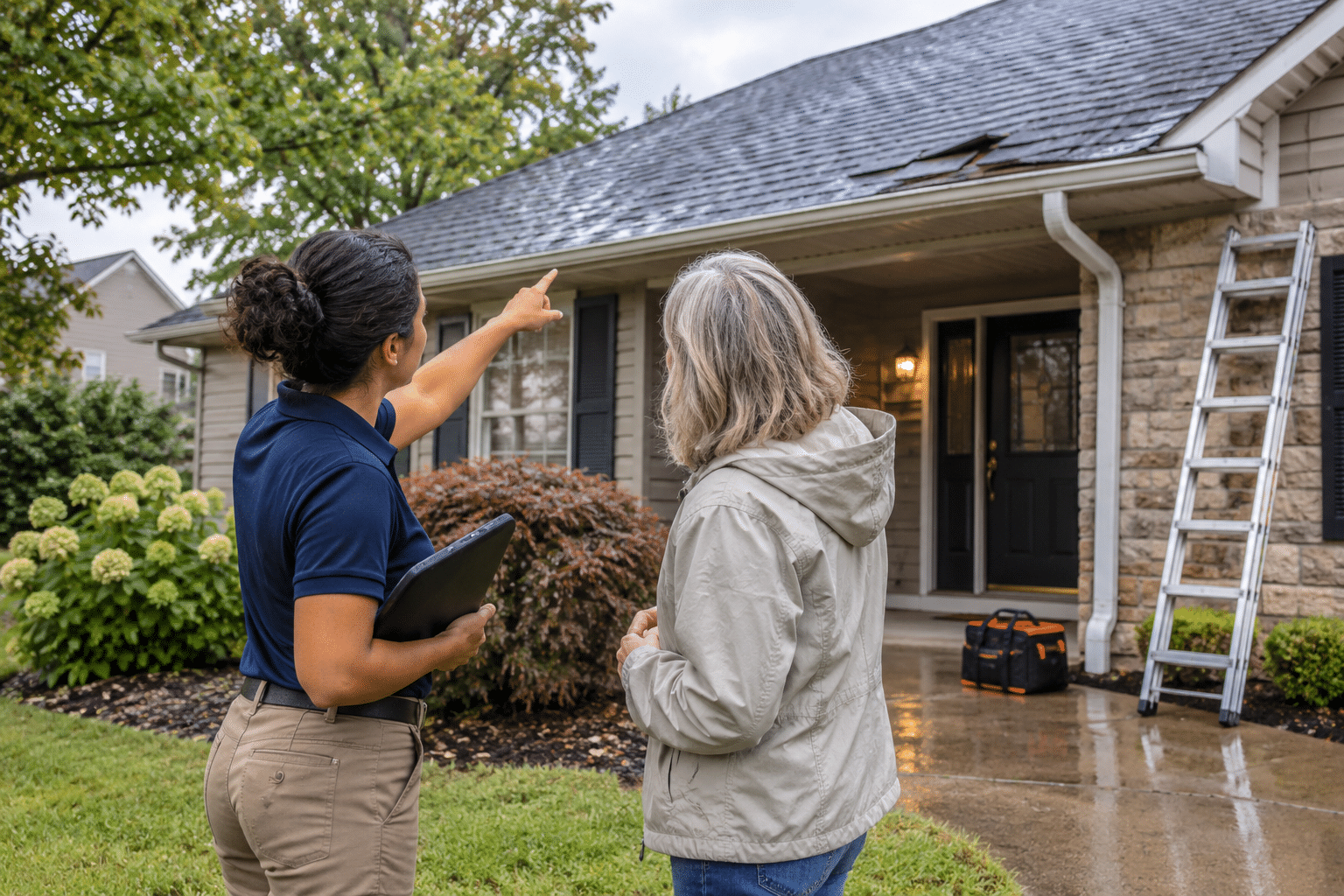
A homeowner notices a brown ceiling stain after heavy rain. Another is comparing a roof replacement before selling a house. A property manager wants documentation for a commercial roof inspection. All three might search for a roofing contractor, but they need different answers—and different next steps.
A useful roofing contractor website should help visitors identify the right service, check whether you cover their property, understand how an assessment works, and contact your team without guessing. It also needs to earn trust in a field where expensive projects and storm-season uncertainty make careful comparisons especially important.
Download: Use our one-page Roofing Website: Leak Inquiry Audit to check the most important customer paths and choose three improvements. The worksheet is available through the form below.
Key Takeaways
- A roofing contractor website must address diverse customer needs, providing clear paths for leaks, repairs, or replacements.
- Include details on what your company does and clarify boundaries for services offered; avoid generic claims.
- Make the contact process for roof leaks straightforward, with minimal required information.
- Explain inspection and estimate processes clearly to reduce customer uncertainty about roofing projects.
- Show verifiable proof of your work, including project photos and customer reviews, to help build trust.
Start with the roofing customer's situation—not your company history
Roofing companies differ. Some focus on residential shingle repairs and replacements, some handle low-slope commercial systems, and others offer inspections, gutters, maintenance or emergency temporary protection. The site should describe what your crew actually does rather than imply that every contractor offers every option.
1. A leak or active damage concern
Someone seeing water inside may be worried about further damage. They need to know whether you inspect leaks, which locations you cover, how to request help, and whether the business currently offers after-hours or emergency response. If you do not provide 24/7 service, say that clearly. A button labeled “Report a Roof Leak” can lead to a short request form and an accurate phone contact path.
Do not invite visitors to climb onto their roofs to identify the problem or take pictures. Explain that any optional images should be taken safely from the ground or inside the building. A photograph may help route the inquiry; it cannot establish a reliable diagnosis by itself.
2. A planned repair or replacement
This visitor may have time to compare roof materials, workmanship, warranties, ventilation questions, estimate processes and scheduling. They need straightforward pages explaining how you assess a roof before recommending repair or replacement. Separate genuine roof-repair services from complete replacements, including when a site visit is required before meaningful pricing.
3. A storm-damage question
After wind or hail, customers may not know whether they need an inspection, temporary protection, repairs or a full replacement. A responsible storm page should describe what your team can assess and document without claiming that every storm-damaged roof qualifies for an insurance-funded replacement. Keep your roofing work and the insurer's coverage decision separate.
Build service pages around real work and real boundaries
Your navigation should let a visitor quickly find the specific job they have. For a residential-focused roofer, useful pages may include roof leak repair, roof replacement, storm-damage inspections, roof maintenance and gutter services when offered. Commercial or low-slope work deserves its own explanations if it is a substantial part of the business.
Each service page should answer: What problem do you handle? Which roof types or properties fit? What is included in the inspection or estimate? What happens after someone contacts you? What is outside your scope? A generic page promising “all roofing solutions” does little to help a homeowner decide whether to reach out.
For an adaptable page structure, see our guide on what a useful service page should include. In roofing, emphasize the roof condition and assessment process rather than presenting replacement as the inevitable answer.
Make the roof leak contact path fast, short and safe
The best leak form is not an entire sales questionnaire. Ask only what your team needs to understand and route the initial request. A good starting set of fields is:
- Name and reachable contact information: a phone number or email, plus preferred way to respond.
- Property address or ZIP code: confirm that the address is actually in your service area.
- Type of concern: active interior water, missing or lifted shingles, visible storm damage, suspected flashing problem, or another issue.
- When it began: today, after a recent weather event, intermittently, or unsure.
- Property and roof type, if known: residential or commercial; asphalt, metal, low-slope or unknown.
- Optional safe photographs: interior staining or a ground-level view, with no requirement to inspect the roof personally.
Offer a separate, less urgent route for planned replacements: roof age if known, existing material, project goals, approximate timeframe and any questions. Do not force a person with an active leak through material-color selections or budget discussions before they can make contact.
After submission, state whether the request arrived, how the team will respond, and what number to use if the situation cannot wait for normal business hours. Only promise a response window that the office can consistently meet. Our contact-form testing guide shows how to confirm that requests actually arrive and reach the right person.
Example confirmation: “Thank you. We received your roof concern and will review the details during our posted business hours. A team member will contact you about next steps. If you have an immediate safety emergency, use the appropriate emergency services.” Adapt this to your real operation; a form receipt is not an appointment confirmation.
Explain your inspection, estimate and project process
A roofing customer may be deciding whether to invite a contractor to their property. Reduce uncertainty by showing the typical sequence: initial inquiry, service-area confirmation, inspection or consultation, findings, written scope and estimate, scheduling, work, cleanup and closeout. Say what depends on weather, material availability, property conditions or permits.
For replacement projects, explain the choices a written proposal may cover: materials, underlayment, ventilation considerations, tear-off or overlay approach where appropriate, flashing, cleanup, payment milestones and warranty terms. Different roof systems require different scopes. The National Roofing Contractors Association's contractor-selection guidance emphasizes written scope, insurance verification, references and clarity about warranties and supervision.
If your company can only give a firm price after examining the property, say so. You might provide examples of what affects estimates—roof complexity, access, layers, materials, decking condition or repairs revealed during work—without inventing a universal per-square-foot price. Our article on explaining service pricing online provides a framework for deciding when to show prices, ranges or estimate explanations.
Show proof that helps owners trust the contractor
Roofing buyers have good reasons to compare carefully. Give visitors relevant, verifiable evidence instead of broad claims such as “the most trusted roofer in town.” The site should make it easy to find:
- Actual project photos with the roof type, broad location, work performed and permission to display the project.
- Licenses or registrations where applicable, with accurate jurisdictional wording; requirements differ by state and locality.
- Current insurance information or a reasonable path to request proof.
- Real reviews and references, presented without manufactured quotations.
- Manufacturer certifications or memberships only when they are current and actually held.
- Clear workmanship-versus-material warranty explanations, including important exclusions and who handles service.
“Lifetime roof warranty” is too vague if the page never says what is covered, which party provides it, or what conditions apply. A short warranty explainer can be more persuasive than a large badge with small-print qualifications.
For commercial work, property managers may need system experience, crew capacity, inspection reporting and documentation. A single-family homeowner may care more about protecting landscaping, cleanup, communication and disruption during the job. Use the proof that answers the customer's specific question.
Discuss storm damage and insurance carefully
Weather events create real urgency—and an opportunity for misleading promises. Your website can describe your inspection process, roof-condition observations, written repair proposals and photographs you provide. It should not promise claim approval, guarantee a new roof through insurance, claim to waive deductibles or imply that your contractor automatically represents the homeowner in an insurance dispute.
Insurance terms and contractor rules depend on jurisdiction and policy language. The National Association of Insurance Commissioners advises consumers to document loss and contact their insurer about the claim process. Roofing websites should direct insurance-coverage questions to the policyholder's insurer or appropriately authorized professional.
For a Wisconsin roofing company, review the state's storm-repair and public-adjusting requirements before publishing any promise about deductibles, claims negotiation or coverage. A nationwide guide should not portray one state's rules as universal. When a customer asks whether a roof requires full replacement, the honest website response is that the property needs a qualified assessment before that conclusion.
Clarify where—and when—you actually work
Roofing is local, but service areas may vary by job size, season, crew availability and property type. List places where you truly accept projects. Do not create dozens of nearly identical town pages just to mention more locations. Explain when commercial, rural or larger replacement projects have different coverage from small repairs.
Keep the website and Google Business Profile aligned. Google's official service-area instructions call for specific, accurate geographic coverage. Give people enough information to check fit without promising immediate dispatch everywhere in a broad region.
Mobile access is essential to test. On a phone, a visitor should be able to open the leak path, tap the number, read hours, see service areas and submit a request without pinching or scrolling through a giant gallery. Test the page with real fingers on a small screen, not only in a desktop preview.
Make the website useful after the first call
A website should also serve existing customers. Consider a simple page describing how to prepare for inspection, access gates or pets, typical noise and parking arrangements during replacement, and where to send questions about scheduling or warranties. Add online payment or document access only if your operation actually supports it securely.
Test the entire inquiry loop quarterly and after changes to forms or routing: submit a clearly labeled test, check notifications, verify the responsible staff member receives it, and confirm the visitor sees an accurate next step. Track inquiries by service type so you know whether the site attracts appropriate work, not just traffic.
A quick roofing website self-audit
- Can a homeowner find the roof-leak contact path within ten seconds?
- Are the hours, emergency limitations and real service area obvious?
- Does your form distinguish active leaks from planned replacement?
- Can the visitor submit safely without roof access or mandatory photographs?
- Does every major service have a specific, truthful explanation?
- Do the inspection, proposal and warranty pages answer practical questions?
- Are credentials, insurance, project examples and testimonials verifiable?
- Does the storm page avoid promises about insurance outcomes?
- Are forms tested end-to-end on phones, including confirmation and routing?
The printable 14-point worksheet adds simple checks and space to choose three improvements. Complete the form below to request the Roofing Website: Leak Inquiry Audit.
Get Your Free Roofing Website: Leak Inquiry Audit
Frequently asked questions
Should a roofing website offer online appointments?
Only when appointment capacity is managed reliably. Many contractors benefit from an inspection request rather than instant booking, especially after storms or when the scope is unclear. Say explicitly whether a request is pending confirmation.
Should a roofer post prices online?
Post clear pricing information when it remains accurate for the service. For complex roof replacement, explaining variables and the estimate process may be more useful than publishing an unqualified flat number.
Do roof-damage photos replace an inspection?
No. Optional photos can help your team understand the concern, but diagnosis, safe access and work recommendations may require an on-site assessment.
Get a Free Website Review
Your roofing website should help someone with a leak find the right first action—and help a replacement shopper understand how to compare proposals. Industry Ignitors can review your existing website and online presence, including service clarity, trust, local visibility, mobile usability and inquiry flow, and identify practical improvement opportunities.